
Think about how much work went into your ad campaign The keyword research, the creative back-and-forth, the budget approvals that took three meetings longer than they should have. Now here’s what a fraudster sees when they look at the same campaign: money sitting on a table.
That gap between how you see your campaign and how they see it is exactly why click fraud drains billions from ad budgets every year without most advertisers noticing. So for the next few minutes, switch sides Look at your own campaign the way a fraudster would Once you understand how they pick targets and make money, click fraud prevention stops being guesswork.
Which Ad Campaigns Do Fraudsters Target?
Fraudsters do not strike randomly; they shop around. Campaigns that bid for costly keywords pay more for each click. An ample daily budget leaves more space to burn without anyone getting suspicious. Programmatic campaigns serve as ideal cover; fake clicks blend seamlessly into millions of impressions. Festive season campaigns? Even better; budgets grow, attentiveness decreases, affiliate campaigns do not escape as well; after all, one fake conversion generates real profit .
But the most telling red flag? No one watching Campaign with poor fraud detection equals open cash register.
Thus, if your campaign became victim of click fraud, it was not just a matter of luck; something in it attracted the fraudsters Not pleasant, but valuable information
How Click Fraud Works: Inside a Fraud Operation
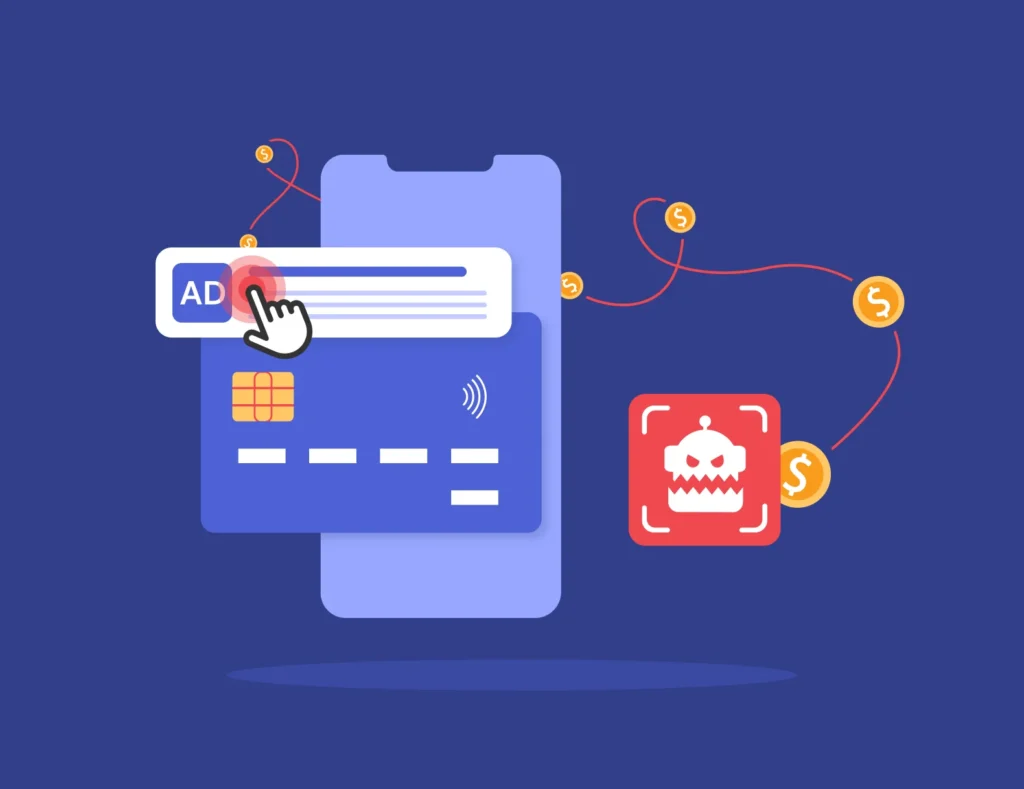
Forget the picture of one frustrated competitor clicking your ad 50 times Click fraud nowadays resembles a mini-business, and takes many forms that most advertisers don’t even know about
There are two kinds of click fraud: real people’s and bot-driven fraud Real human activity is easy Click farms hire employees to click on ads and download apps all day Your competitors click your ads only to waste your budget In incent fraud, users earn some points for clicking ads, they click to earn the reward but not to become your customer
Bot fraud is much more sophisticated: some bots disguise junk websites as premium ones in order to make advertisers pay extra for poor-quality traffic (domain spoofing) Some mimic perfectly human behavior, scroll the webpage, click ads and spend time on them (headless browser bots) Some take credit for app installations by sending a spoofed click before the installation Botnets distribute clicks from a great number of infected devices in order to simulate real user activity
Bots today constitute 37% of all web traffic, and have been doing it for six years straight. Many masks, one plan This is the structure of a typical operation
Why Click Fraud Goes Undetected
Since each fraud detection rule gives fraudsters another lesson.
IP addresses were blocked if used more than once, so fraudsters had to start using residential proxy rotation services. All clicks come from brand new IP addresses resembling normal household ones .
Platform detected bots based on click timing Bots have learned to randomize Platforms detected devices based on device IDs Devices have been spoofed Then platforms have started detecting engagement and this is where it gets truly impressive Bots scroll down the page, move the mouse around and stay on the page long enough to seem interested in order to leave then.
Advertisers’ fraud detection filters were developed five years ago. Today’s fraud knows all about them.
Signs of Click Fraud in Your Ad Campaigns
Still, no bot is perfect Fake traffic behaves in ways real customers simply don’t, and the cracks show up in your data if you know where to look
- Your CTR suddenly jumps and you changed nothing
- Clicks pile up, conversions don’t
- Visitors bounce within seconds
- Traffic arrives from cities or countries you never targeted
- The same device fingerprints and IP ranges keep coming back
- Strange bursts, like fifty clicks in ten minutes and then silence
- Activity at 3 am when your actual audience is asleep
One of these on its own could be anything Three or more together? Stop and dig You can run this check today with the data already sitting in your dashboard
Click Fraud Prevention: How Ad Fraud Detection Helps
The goal of click fraud prevention isn’t catching every single bot It’s making your campaign a bad deal Here’s what does that:
- Behavioral AI detection: Bots imitate actions, not instincts Real people hesitate, wander, click imperfectly Machine learning picks up on the things bots can’t fake, and suddenly all that “human-like” traffic doesn’t look so human anymore
- Real-time blocking: A fraudster earns only when a click gets billed Stop the invalid click before it charges your account, and their entire operation works for free
- Full-funnel validation: Clicks alone prove nothing Validate the whole journey, from impressions to clicks to installs and conversions, so fraud has no stage left to hide in
- Cross-channel protection: Fraud migrates When web gets hard, it moves to app When app gets hard, it moves to CTV Covering every channel means leaving no door open, because the open one is the door they’ll use.
Conclusion
When you started reading this, your campaign looked like easy inventory: Good keywords, decent budget, nobody checking too closely Now you know better And here’s the thing about fraudsters: they don’t fight for territory The moment a campaign stops paying, they move on to one that still does.
You don’t have to outsmart every one of them. You just have to be more expensive to rob than the campaign next door Start with an audit of your ad traffic validation. Find out how much of your spend
FAQs
What is click fraud?
Click fraud is when bots, click farms, or bad actors click on your ads with no real interest in buying The clicks look genuine but only drain your ad budget and distort your campaign data.
How do I detect click fraud in my campaigns?
Look for high clicks with low conversions, sudden CTR spikes, traffic from locations you never targeted, visitors bouncing within seconds, and repeating IPs or device fingerprints Three or more of these together is a strong signal.
Doesn’t Google Ads already block invalid clicks?
Google’s built-in filters catch basic, obvious fraud But modern bots mimic human behavior, rotate IPs, and spoof devices, which lets a large share of fake clicks slip past platform-level protection